
A Quick and Helpful Introduction to the ATP Bioluminescence Assay
by Katharine Martin

by Katharine Martin
Cell viability assays are used by many researchers to evaluate cell health. This assay category is useful for experimental optimization, understanding cell metabolism, studying the effects of a certain treatment, etc. In this article, we will specifically focus on the ATP bioluminescence assay, which uses the relationship between ATP, luciferin and luciferase to help determine the number of live cells.
What is the ATP bioluminescence assay?
How does the ATP bioluminescence assay work?
What applications use the ATP bioluminescence assay?
The ATP bioluminescence assay is based on the presence of ATP in metabolically active (living) cells, as intracellular ATP rapidly diminishes after cell death. By measuring ATP-dependent bioluminescence, researchers can estimate the number of viable cells within a sample.
In viable cells, ATP is maintained through active metabolism. Following cell death, ATP production ceases and intracellular ATP levels generally decline rapidly. Therefore, ATP-dependent bioluminescence can be used as an indicator of metabolically active, viable cells.
Under controlled conditions and within the assay's linear range, the bioluminescence signal correlates with ATP concentration, which in turn can reflect the number of viable cells in the sample (Brovko, 2010).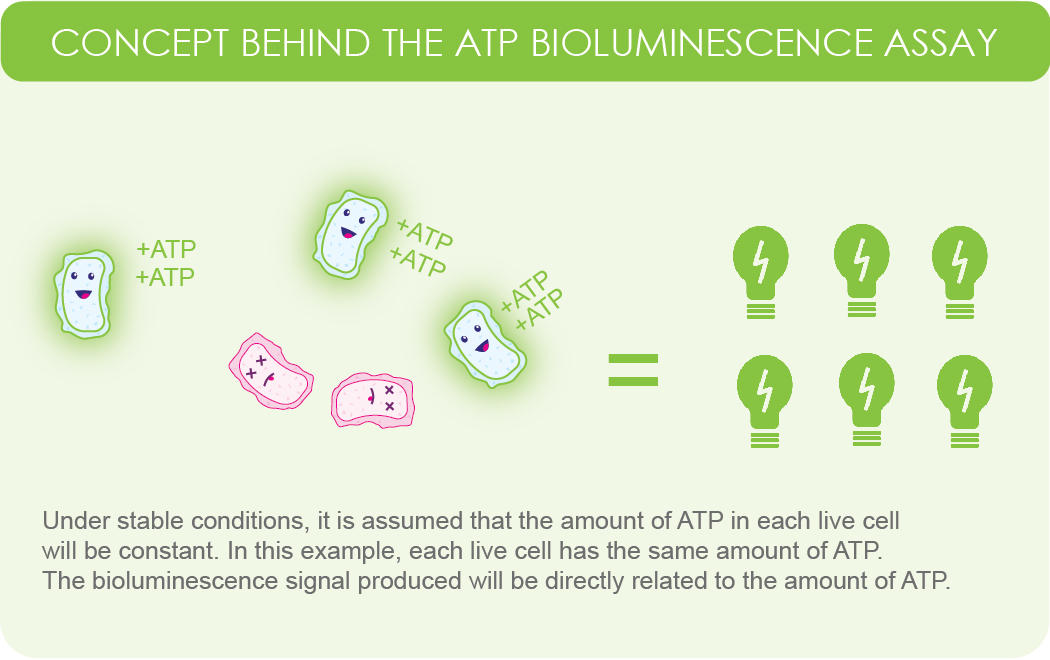
Figure 1. Simplified illustration showing the relationship between cellular ATP and bioluminescent signal. Under controlled conditions, ATP levels can correlate with the number of metabolically active, viable cells, allowing signal intensity to be used to estimate viable cell number.
The ATP bioluminescence assay typically works by lysing cells to release intracellular ATP and then measuring that ATP through the firefly luciferin-luciferase reaction. Many modern assay reagents combine cell lysis and ATP detection in a single step. The resulting luminescence can then be used to estimate the number of metabolically active, viable cells in the sample.
When cells lose viability, ATP production ceases while remaining ATP continues to be consumed and degraded. As a result, intracellular ATP levels rapidly decline after cell death.
But to really understand how the ATP bioluminescence assay works, we need to understand the luciferase reaction.
There are two steps in the luciferase reaction. The first step is the ATP-dependent adenylation of the substrate luciferin.
In the second step, luciferyl adenylate reacts with molecular oxygen, ultimately producing electronically excited oxyluciferin. As the excited oxyluciferin returns to its ground state, energy is released as visible light (Belanger & University of Rochester Introductory Biochemistry, 2018).

Figure 2. Shows the basic firefly luciferase reaction involving ATP and D-luciferin. Light is emitted as excited oxyluciferin returns to its ground state.
What this shows us is that ATP is a fundamental compound within the luciferase reaction. Researchers can use this reaction to generate a quantitative luminescence signal that reflects the amount of ATP in the sample and, under controlled conditions, estimate the number of viable cells.
The ATP bioluminescence assay is used for many studies such as (Riss et al., 2016), (Brovko, 2010):
AIB Staff. (2013, October 11). A Q&A on ATP Bioluminescence assay. Retrieved March 22, 2021, from https://www.qualityassurancemag.com/article/aib1013-atp-bioluminescence-assay/
Belanger, S., & University of Rochester Introductory Biochemistry (Producers). (2018, May 15). Luciferase [Video file]. Retrieved March 22, 2021, from https://www.youtube.com/watch?v=odN92KbH8Bo
Brovko, L. (2010). Bioluminescence and fluorescence for in vivo imaging: In vivo optical imaging (Vol. TT91). Bellingham, WA, Washington: SPIE Press.
Riss, T., Moravec, R., Niles, A., Duellman, S., Benink, H., Worzella, T., & Minor, L. (2016). Cell Viability Assays. The Assay Guidance Manual.

In the movie “My Big Fat Greek Wedding,” the father of the bride believes that the glass cleaner Windex® is a cure-all for any and...

If you find yourself questioning the difference between various luciferase or luciferin types, this guide will set it all straight. Find out: what to look...

Antibiotics are important tools used to select for particular cell populations. For example, when bacteria are transformed with a plasmid, antibiotics are used to kill...

Gold Biotechnology stands at the threshold of operating for 40 years. To celebrate this milestone, we’re looking back at the amazing advances made in biotechnology...


